
Access and Custody During a Domestic Violence Case in Ontario
Can you see your kids during a domestic violence case in Ontario? Learn how custody and access decisions are made while criminal charges are pending, and what protections are in place for children.
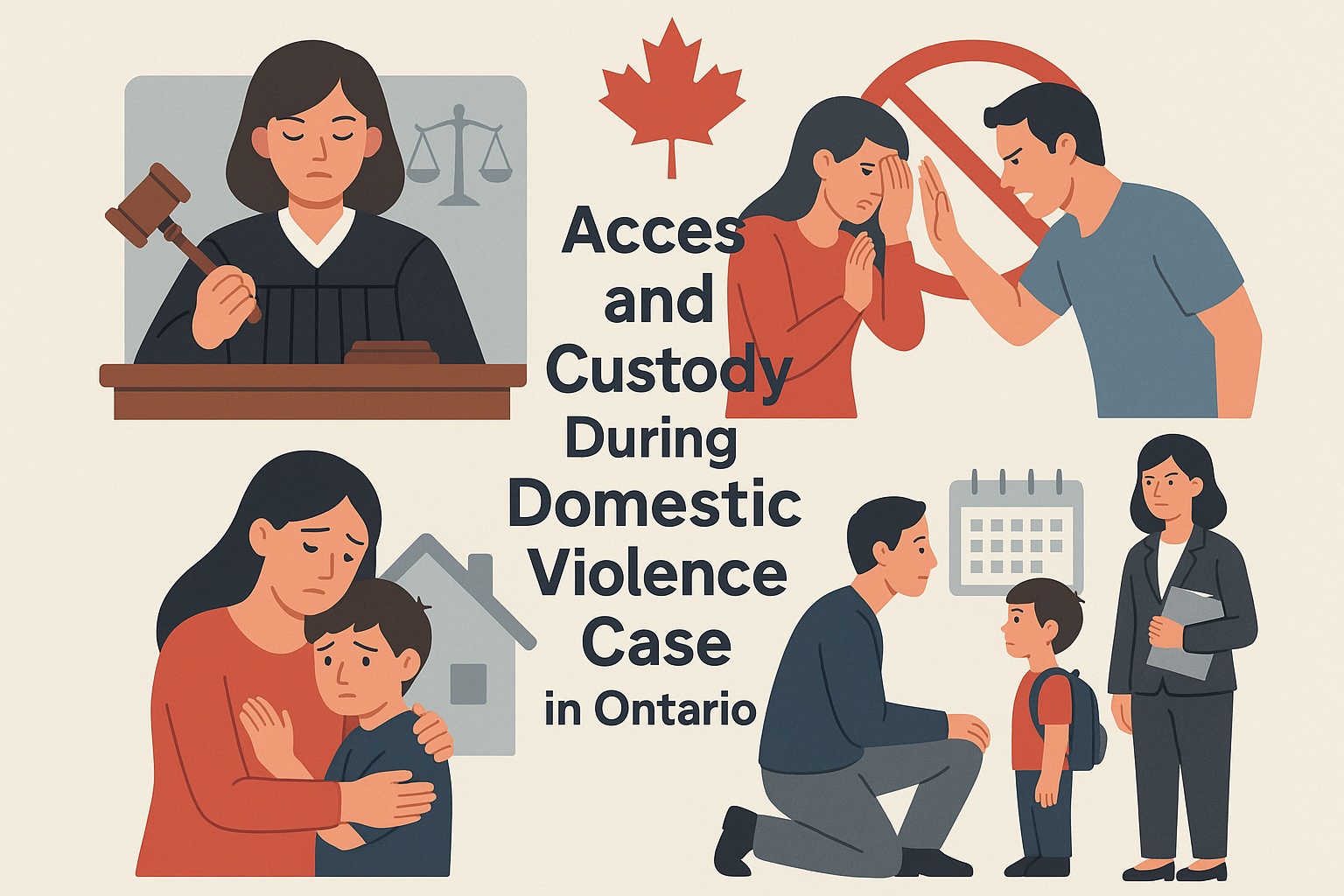
When one parent is charged with domestic assault or other related offences, child custody and access decisions become more complex. The courts in Ontario are required to prioritize the child’s best interests and safety—especially when domestic violence is involved.
This post explains what happens to parenting time (access) and decision-making (custody) while a domestic violence case is active.
⚖️ Does a Criminal Charge Automatically Stop Access?
Not necessarily. Being charged with domestic violence does not automatically end parenting time, but it does trigger greater scrutiny by the courts.
The outcome depends on:
The nature of the allegations
Whether the children were present or exposed
The accused’s past behavior
Bail or release conditions
🚫 Bail Conditions That Affect Parenting Time
When the accused is released on bail, conditions may include:
No contact with the other parent
No contact with the children, especially if they witnessed abuse
No return to the family home
These conditions can limit or prevent parenting time until reviewed by a family court judge.
👩⚖️ Who Decides Parenting Time During an Active Case?
Parenting arrangements may be decided by:
Family Court, through a motion or temporary order
Criminal Court, through bail conditions
CAS (Children’s Aid Society) involvement, if child protection concerns exist
Sometimes, Family Court and Criminal Court overlap—each may issue different but legally binding restrictions.
🛡️ Can Supervised Access Be Ordered?
Yes. If there’s a safety concern but parenting time is still possible, courts may order:
Supervised access at a neutral location
Third-party supervision (e.g. a family member)
Virtual access through phone or video calls
👨👩⚖️ What About Custody and Decision-Making?
In Ontario, "custody" is now called "decision-making responsibility". Courts may:
Suspend or limit the abusive parent’s authority
Give the non-abusive parent sole decision-making
Order that both parents consult but only one makes final decisions
💡 Courts consider past abuse as a significant factor in determining a parent’s ability to act in the child’s best interests.
📌 Summary: Access and Custody During a Domestic Violence Case
✅ Bail conditions may limit or suspend contact with children
✅ Courts focus on the child’s safety and emotional well-being
✅ Family court can issue temporary custody/access orders
✅ Supervised visits or no access may be ordered in serious cases
✅ The abusive parent may lose decision-making rights
📞 Where to Get Help
Family Law Information Centre (FLIC) – Free advice at Ontario courthouses
Legal Aid Ontario – 1-800-668-8258
Children’s Aid Society – If involved, work with your assigned caseworker
Office of the Children’s Lawyer (OCL) – May be appointed to represent the child
Assaulted Women’s Helpline – 1-866-863-0511
Frequently Asked Questions (FAQs)
1. If my ex-partner is charged with domestic assault, will they lose custody of our children?
Not automatically. However, a domestic violence charge is taken very seriously by the family court. A judge must consider the abuse when deciding on decision-making responsibility (formerly custody) and is likely to put orders in place that limit the abusive parent's ability to make decisions, at least temporarily. The children's safety and well-being are the only priority.
2. How do criminal bail conditions affect parenting time (access)?
Criminal bail conditions, such as a "no-contact" order with the other parent or children, override any existing family court order. The accused parent must follow the criminal court's conditions. They will need to go to family court to ask for the parenting arrangements to be clarified or changed in a way that does not violate their bail.
3. What is the difference between supervised access and supervised exchange?
Supervised access means the entire visit between the parent and child is monitored by a supervisor. Supervised exchange means only the pick-up and drop-off are monitored by a supervisor to ensure there is no contact or conflict between the parents; the visit itself is unsupervised.
4. My ex was charged with domestic violence, but the police let them go. Can I still get a family court order for my protection?
Yes, absolutely. The family court and criminal court are separate. You can (and should) seek a restraining order and an order for exclusive possession of the home in family court, regardless of what happens in the criminal case. The standard of proof is different, and the family court's main focus is ensuring your and your children's future safety.
5. Will my children have to testify in court?
It is very rare for children to testify in family court. Instead, a judge may get information about the children's views and needs through a neutral third party, such as the Office of the Children's Lawyer (OCL) or a social worker who can conduct an assessment.
6. Where can I get help with a custody case involving domestic violence?
It is critical to get legal advice. You can contact Legal Aid Ontario to see if you qualify for a free lawyer. You can also get support and referrals from your local women's shelter or the Assaulted Women's Helpline (1-866-863-0511).